Patrick is a system that I created to save time in the daily management of my team. My initial objective was deliberately ambitious: reduce daily follow-up meetings as much as possible and replace them with an assistant that is always available, capable of following up with the right people, monitoring the progress of tasks and alerting me when a subject seems blocked.
01Why I created Patrick
Before Patrick, we used OpenProject to organize part of our tasks. The tool fulfilled its role, but it required employees to log in regularly, find the right project, open a task, modify its status then enter a progress note.
The problem wasn't actually the tool. The problem was the effort required to keep the information up to date. The more actions required to update a task, the more likely it is to be postponed or forgotten.
So I imagined a system capable of centralizing tasks, projects, notes, meeting minutes and absences, while removing unnecessary administrative actions as much as possible. Patrick now allows team members to manage their tasks independently, add information, create projects, attach reports and plan their leave.
02Replacing forms with conversation
The main difference between Patrick and a traditional task manager is its mode of interaction. To create or modify information, the user does not need to go through several screens. All they have to do is speak with Patrick, in writing or by audio message.
Add a task to prepare the Esker flow before Friday, assign it to Sonia and indicates that we are waiting for the contractor to return.
Patrick interprets the request, identifies the action to be performed and then uses the functions available to it to record the task. This choice responded to a simple desire: to keep the interaction as natural as possible. Employees already know how to speak, explain a situation and answer a question. It was therefore not necessary to impose on them the learning of a new interface for each action.
03Making adoption easier through natural interaction
In my team, this conversational operation made it possible to achieve a 100% adoption rate. This measurement remains specific to our context and the size of the team, but it confirms an intuition: a tool is much more easily adopted when it integrates with existing habits rather than asking users to completely change the way they work.
The team did not need to learn a succession of menus, buttons or forms. They simply continued to do what they already knew how to do: explain, exchange and give information. The difference is that the interlocutor is now an artificial intelligence capable of transforming the conversation into concrete actions in the management system.
04Purpose-built local AI
Patrick does not need to use the most powerful model on the market. The tasks it must perform are relatively defined: understand a request, identify an intention, extract useful information then trigger a specific function.
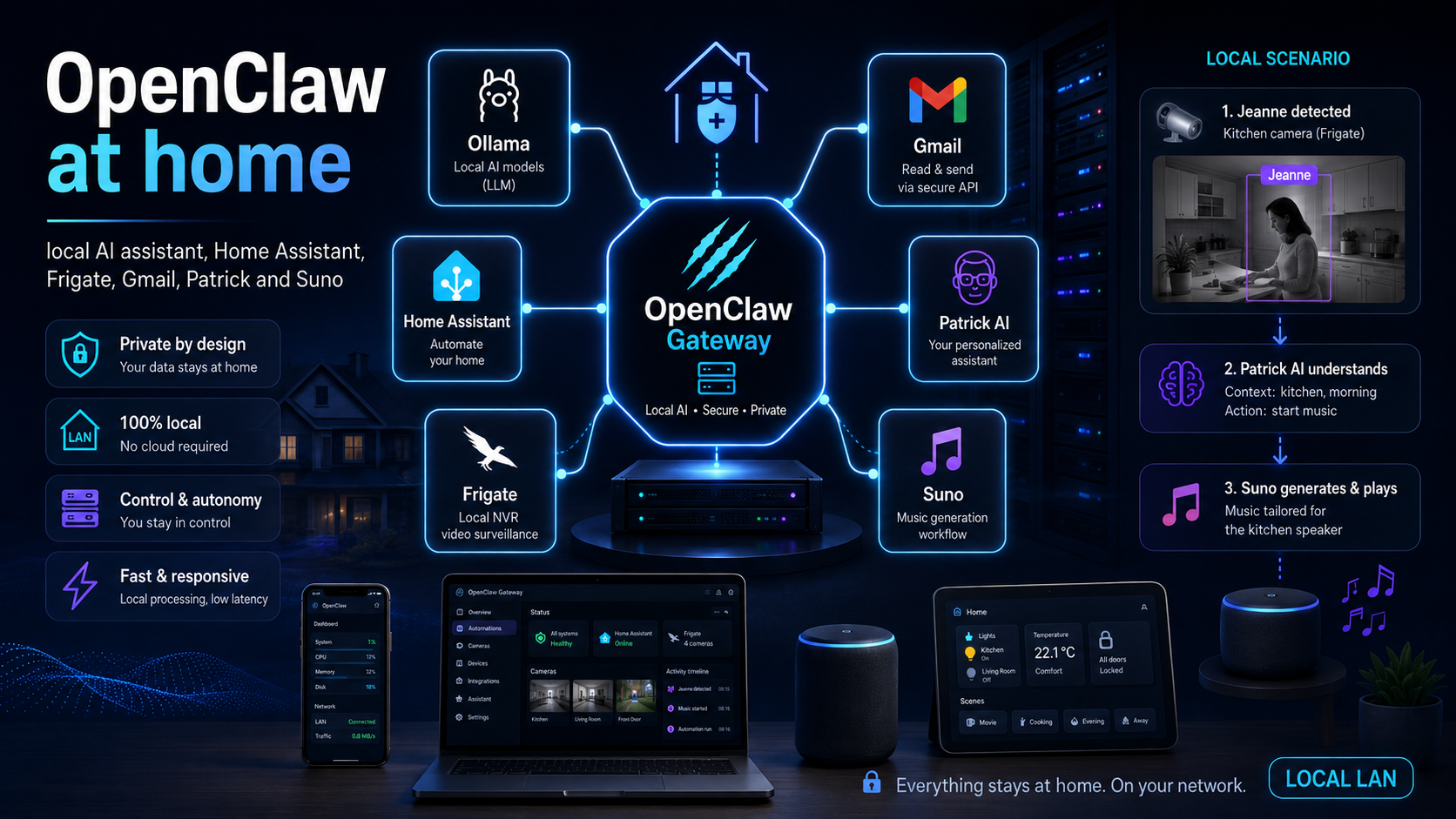
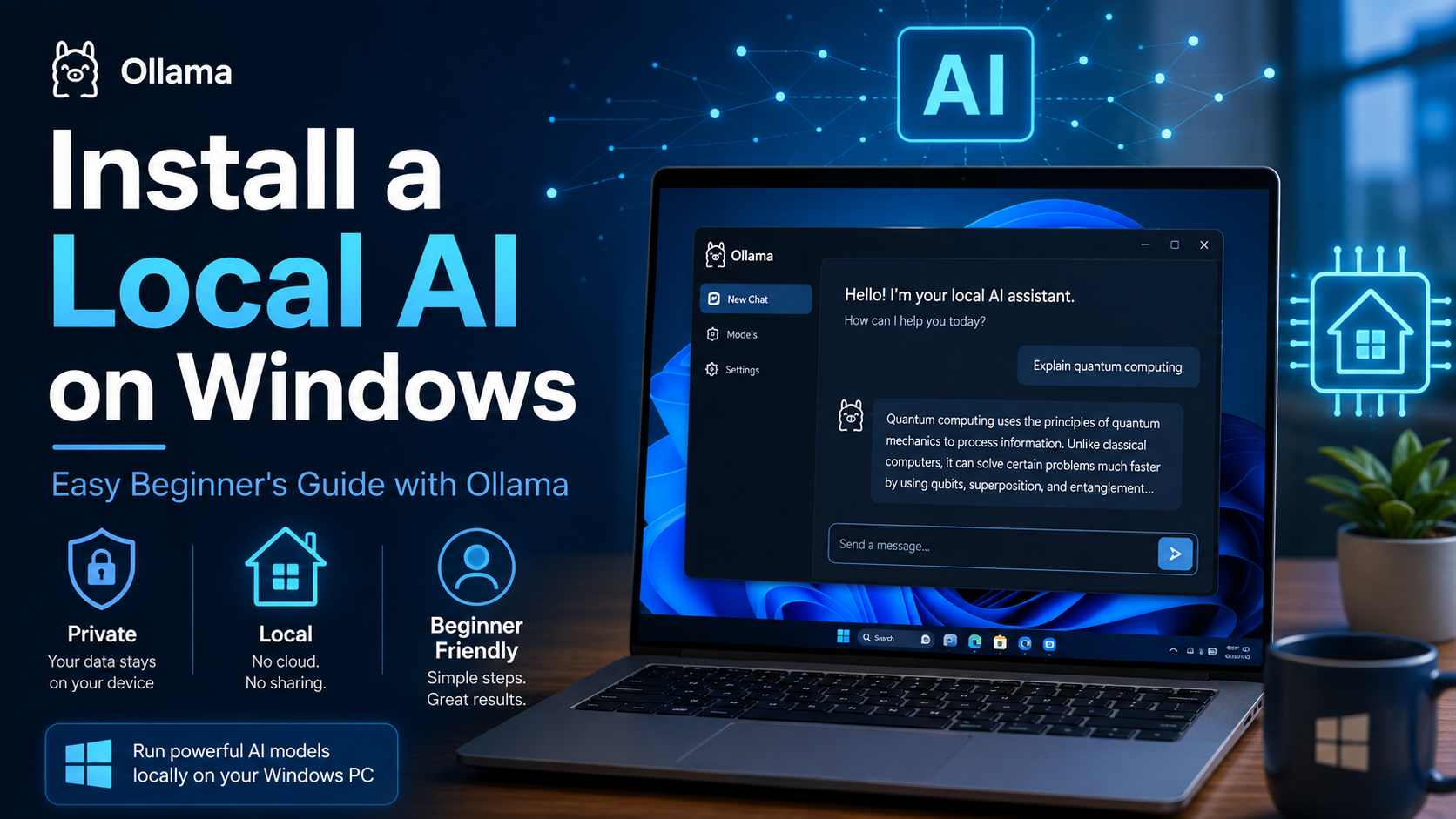
I therefore favored a model from the Gemma family executed locally with Ollama. This choice makes it possible to maintain a controlled architecture and limit dependence on external services for daily exchanges.
The model can use tools, which I call skills: create a task, modify a status, add a note, search for a project, prepare a summary or consult a person's schedule. The intelligence of the system is therefore not based solely on the model. It is mainly based on the quality of the functions available, the rules that govern their use and the way in which the data is organized.
05Handling errors and user feedback
Like any system based on artificial intelligence, Patrick can make mistakes. It may misinterpret a sentence, choose the wrong action or record information incompletely.
So I set up a very simple reporting mechanism:
BUG PATRICK: The task was assigned to the wrong person.
The system then stores the report with the context necessary for its analysis. This feedback makes it possible to identify recurring errors, improve processing rules and gradually improve Patrick. A business AI should not be considered infallible: it must be observable, correctable and capable of leaving a trace of its actions.
06Why a visual interface became necessary
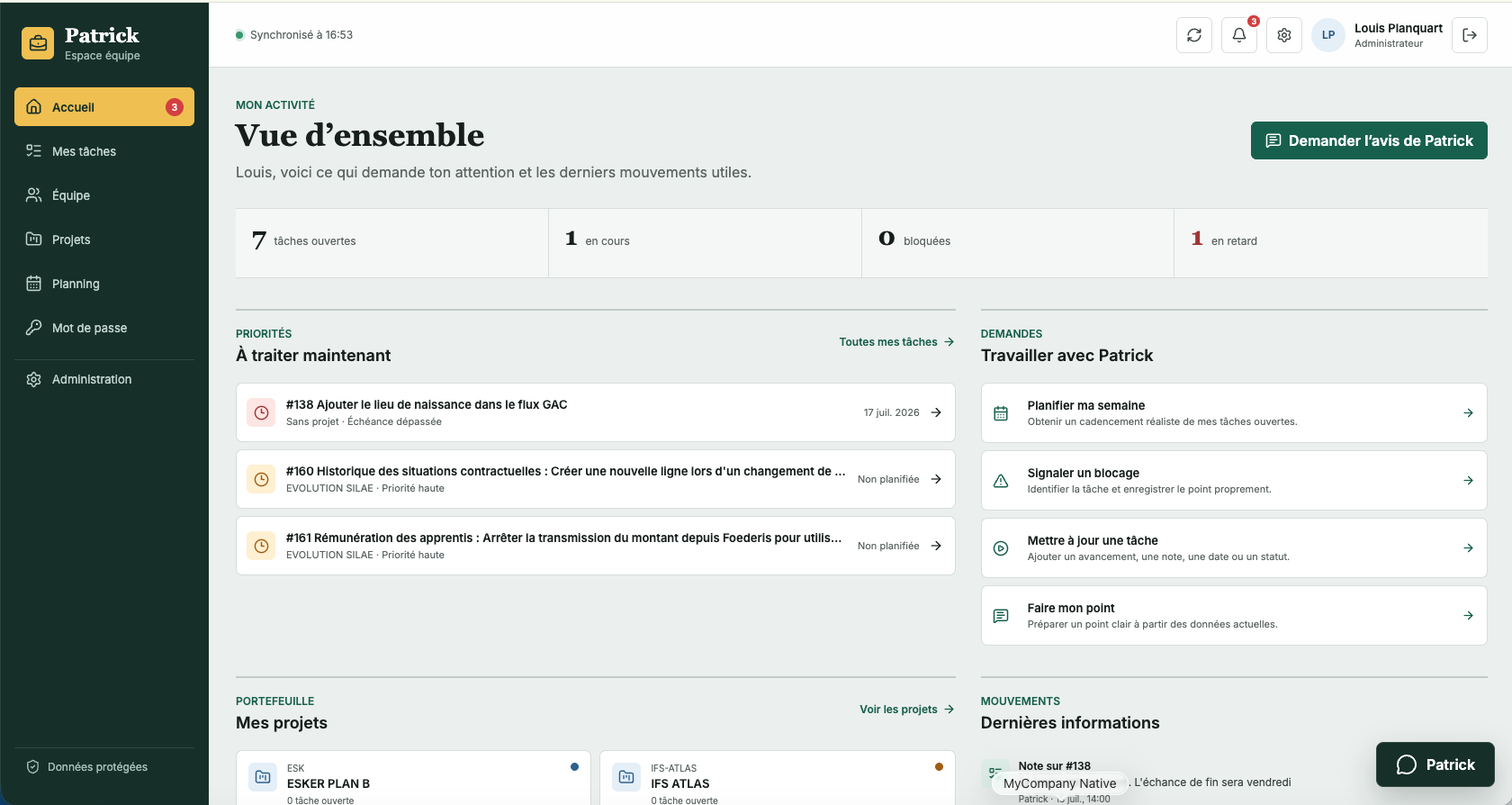
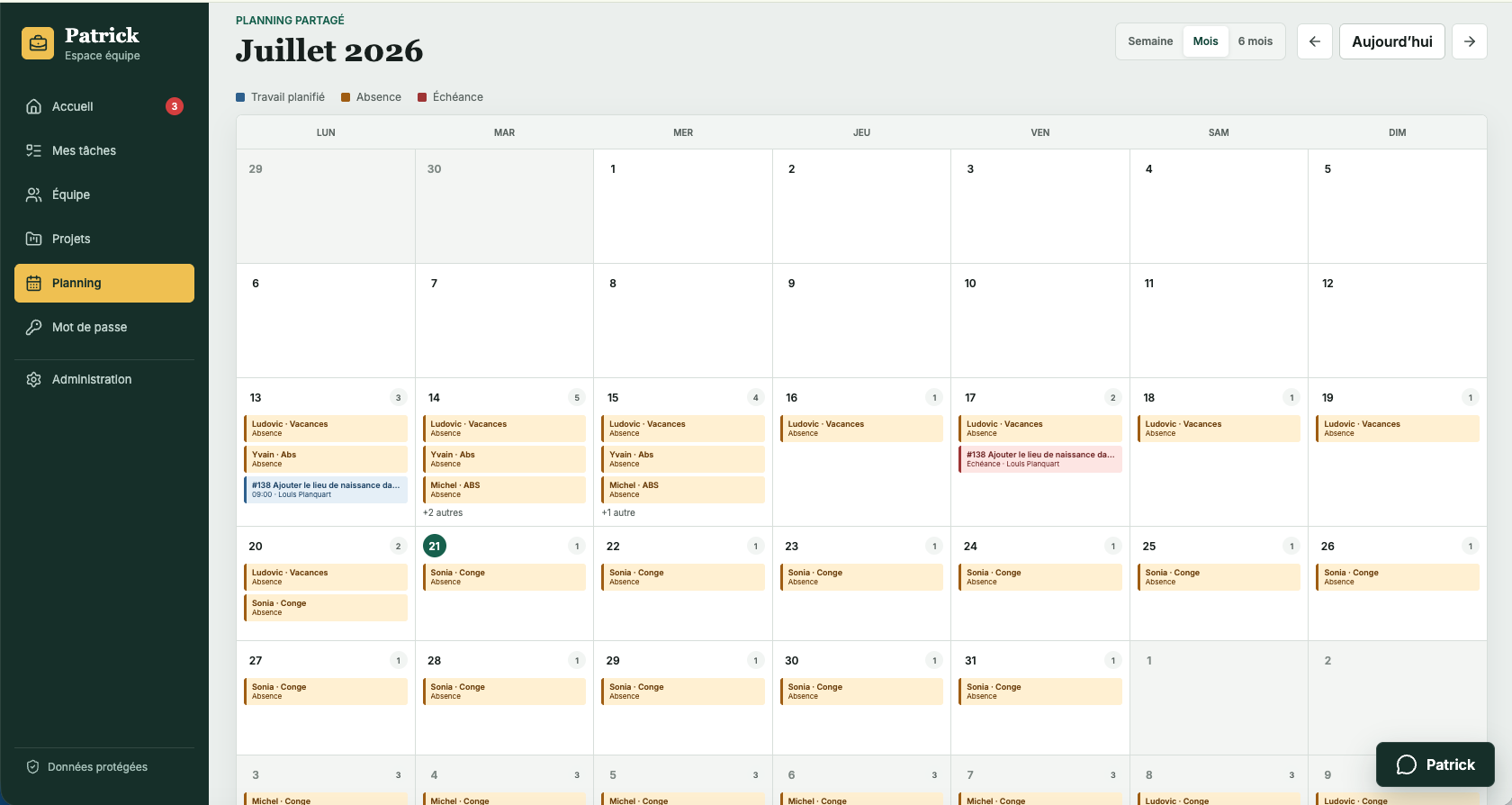
Initially, I wanted all interactions to be through conversation. However, real-world use revealed another need. Some employees manage a large number of tasks. They naturally wanted to have a view allowing them to quickly consult their own work items, their colleagues' tasks and the absence schedule.
A web interface has therefore been added. Conversation remains the main way to create or modify data, while the interface is mainly used to consult it, filter it and obtain an overall vision. A conversational interface does not systematically replace a visual interface: conversation is effective for taking action, while the dashboard often remains more effective for observing.
07Task tracking inspired by CRM
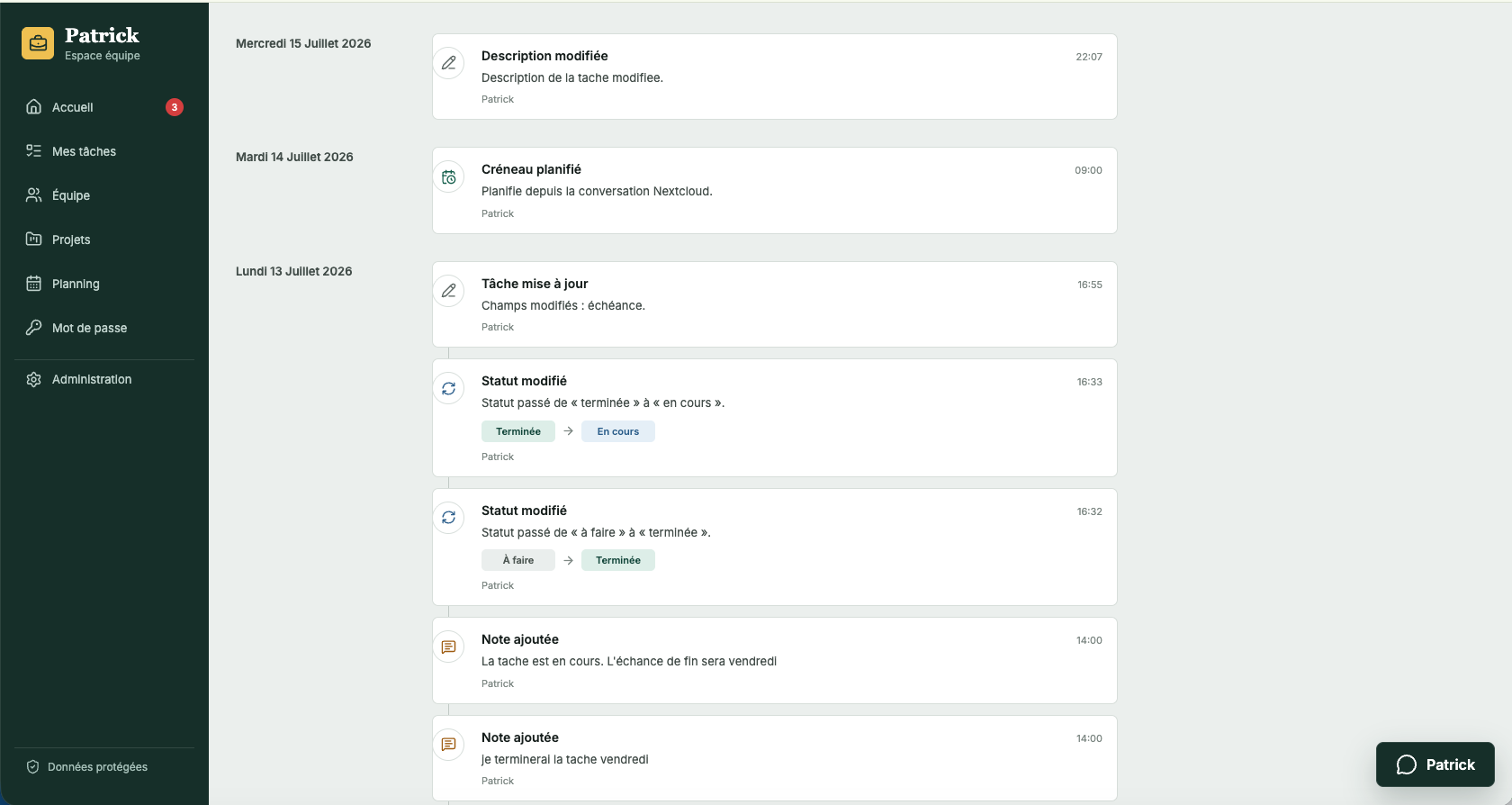
Over the course of requests, Patrick has developed into something akin to a CRM applied to tasks and projects. Each task now has a history: status changes, notes added, people involved, reminders made and important events.
It thus becomes possible to quickly understand how a subject has evolved over time. The system also allows several people to be assigned to the same task or project. This development responds to a simple reality: important topics are not always handled by a single person.
08Anticipating issues from conversations
Patrick may also be present in some shared channels used by the team. Most of the time he remains silent. It analyzes authorized exchanges and identifies messages likely to contain an action, a decision or a blocking point.
In the administration interface, it then offers me a list of potential tasks to create. It does not necessarily create each task automatically: the manager can validate, modify or ignore the proposal. This function makes it possible to detect subjects that have not yet been formalized and to be more proactive when a discussion reveals a risk, a dependency or an action that could be forgotten.
09The team leader’s control tower
The administration interface is Patrick's control tower. It allows the team manager to view all tasks, modify them, reassign them and identify subjects that require particular attention.
It can also automatically prepare reports on the week's progress, produce project summaries and display updated indicators. The objective is not to accumulate KPIs, but to quickly answer a few simple questions: which tasks are blocked, which projects are behind schedule, which people are waiting for a decision and which subjects have not evolved for several days?
10Personalized reminders for each employee
Patrick contacts team members according to a personalized schedule. He can remind them of planned tasks, ask for a progress report or ask a specific question on a subject. Reminders are not the same for everyone: their frequency and content can be adapted to the role of the person, their habits and the nature of their responsibilities.
This feature reduces downtime between two tasks and prevents a colleague from getting stuck simply because they don't know what topic to tackle next. However, it must remain configurable: a useful reminder can quickly become a nuisance if it is too frequent, poorly worded or sent at the wrong time.
11Limits not to be ignored
Patrick brings a real time saving in my context, but it should not be presented as a perfect solution. It depends on the quality of information provided by users, can make interpretation errors and requires strict authorization rules as well as complete logging of sensitive actions.
We must also prevent automation from replacing all human exchanges. Some discussions need real dialogue, particularly when they concern a personal difficulty, a disagreement, an important decision or a need for support.
Finally, Patrick is more suited to my organization than OpenProject or Microsoft Project for certain daily uses. This does not mean that it is objectively superior to these tools in all contexts. These tools address much broader planning and project management needs.
12An assistant, not an artificial team leader
Patrick has become the team manager's super assistant: versatile, available and capable of adapting to different knowledge-work roles. It can support a development team, a functional team, field sales teams or any organization needing to better structure its tasks, reminders and reports.
Its real strength is not to replace the manager. It is to take over some of the repetitive work in order to allow the manager to focus on the people, decisions and difficulties that really need his attention.
Comments
0 commentsNo published comments yet. Be the first to respond.