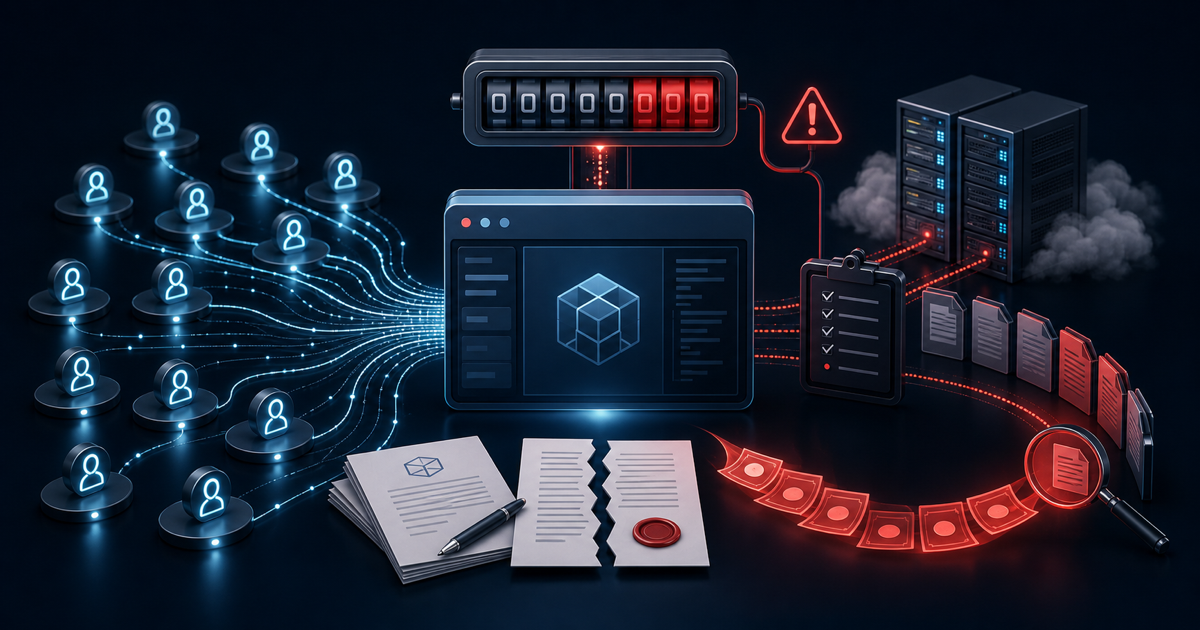
In my first article about PC SOFT’s new session fee, I explained that the vendor had crossed a line by seeking to charge for the use of applications built by its ecosystem. PC SOFT’s latest video does not undermine that analysis in any way. On the contrary, it gives it figures, an official definition and an enforcement mechanism. PC SOFT is clarifying its model, yes. But that clarification confirms exactly what I was criticizing.
01The video confirms my first article
Until now, PC SOFT could still suggest that the community had misunderstood the new offers. This time, the company itself explains the principle.
An application compiled with WINDEV is assigned a number of sessions. Those sessions have an annual price. Their number depends on how the end customer uses the solution. The scope is declared, negotiated, written into a contract amendment and may later be checked through an audit.
This is therefore no longer a fear, a rumour or speculation from the community. It is a new way to monetize applications built with PC SOFT tools after they have been delivered.
02How PC SOFT defines a session
PC SOFT defines a session as an executable used by one user on one machine, whether or not that executable accesses a database.
The video also states that a user corresponds to a Windows account. The word “session” therefore does not appear to mean only a concurrent connection or a technical session open at a given moment. It is tied to the use of the executable by a Windows account.
One executable
The principle applies to the application compiled and used at the end customer’s site, not only to the developer’s IDE.
One Windows account
The video associates the user with a Windows account, but does not yet explain every case involving shared accounts, RDS or service accounts.
With or without a database
An application remains in scope even when it does not access a database.
Grouped as one solution
Several executables may be grouped together when they belong to a single software solution.
The wording is skilful. “Session” normally suggests temporary consumption. In practice, PC SOFT is attaching an annual price to the use of a solution by a Windows account.
03€290 per year to use an executable
The video presents three price levels for one session:
| Announced plan | Price per session | Commitment or condition |
|---|---|---|
| List price | €290 per year | Announced list price outside any special offer. |
| Solutions & Services offers | €225 per year | Announced session price under the new offers. |
| Three-year commitment | €75, then €150, then €225 | The price increases progressively over the three years. |
The phased pricing does not remove the cost; it merely makes it easier to accept at the outset. One session costs €450 over three years, an average of €150 per year, before reaching €225 in the third year.
04The 500-user ERP: the absurd scenario is avoided
The most useful part of the video is a concrete example:
- an ERP made up of ten executables;
- two databases used by those executables;
- 500 end users.
A strict reading of the definition could have led to ten executables multiplied by two databases and then by 500 users.
PC SOFT explicitly rejects that calculation. The company considers the whole system to be one software solution used by 500 people. The announced result is therefore 500 sessions.
This clarification avoids the most extreme scenario imagined by part of the community. It does not make the result insignificant: 500 users still mean 500 sessions.
| Mechanical projection for 500 sessions | Resulting amount | How to read it |
|---|---|---|
| 500 × €290 | €145,000 per year | Projection based on the list price. |
| 500 × €225 | €112,500 per year | Projection based on the price announced in the offers. |
| 500 × €75, then €150, then €225 | €225,000 over three years | €37,500 in the first year, €75,000 in the second and €112,500 in the third. |
Even with an official definition and a six-minute example, the actual price cannot be known without going through the sales team. That lack of reproducible pricing is at the heart of the problem.
05Who actually creates the value?
PC SOFT
Provides the IDE, compiler, WLanguage, frameworks and some runtime components.
The developer or software publisher
Analyses the requirements, designs the product, writes the code, tests, documents, deploys, fixes issues and carries the commercial risk.
Our end customer
Buys a business solution and already pays its supplier to create, use and maintain it.
The business value
Comes from the business rules, processes, data, interfaces and support built around the application.
PC SOFT is almost invisible to the end user. The company does not gather their requirements, train their teams, handle their functional incidents or guarantee their day-to-day operations.
It is therefore difficult to accept our user count becoming a revenue base for PC SOFT. The vendor is seeking a share of the value created by its ecosystem without bearing most of the costs and risks that made that value possible.
06The “reasonable judgment” pricing bazaar
PC SOFT says it will apply a rule of “reasonable judgment” to group executables that belong to the same solution.
That phrase should concern any company preparing a budget. “Reasonable judgment” is neither a metric, a precise clause nor a reproducible calculation method. It looks more like a market negotiation: a displayed list price, an offer price, an Early Adopter discount, phased pricing over three years and then a final price decided after discussion.
The issue is not even whether favouritism can be proven. The issue is that PC SOFT is building a pricing model in which proving the absence of favouritism becomes impossible. Two comparable customers have no public price grid with which to check that they are being treated under the same rules.
This flexibility lets PC SOFT reduce the most absurd cases, but it also puts the vendor in the role of arbiter. It defines what counts as a solution, what must be grouped, what must be declared and what may be reassessed later.
07Sales representatives turned “tax advisers”
PC SOFT says it has around 14,000 customers and acknowledges that it does not know their exact business, applications or sales models. The vendor now asks them to complete a form describing how they use its tools.
The sales team is presented as a team of advisers, “a little like tax advisers”, responsible for optimizing the offer.
Custom pricing also prevents transparent comparisons. Each company negotiates alone, without knowing what discounts, exclusions or interpretations have been granted to other participants in the ecosystem.
End customers thus become the raw material for this new pricing model. PC SOFT wants to know their number, their usage and the architecture of the solutions delivered to them, even though they never chose PC SOFT and generally have no relationship with the vendor.
08WEBDEV: charging for the infrastructure too
For WEBDEV, PC SOFT will not apply the same system as it does to WINDEV executables. The video explains that measuring the number of sessions would be too complex, particularly because of web-service calls.
Billing will therefore be based on three elements:
Number of cores
The CPU capacity allocated to the server becomes part of the metric.
Amount of RAM
The memory available to the application is also included in the calculation.
Number of servers
Adding nodes or instances may increase the billable scope.
Adding a second server for high availability, increasing RAM to absorb a rise in load or creating an additional node to secure production may now have a contractual impact.
The video does not provide the calculation formula. We therefore do not yet know how virtualized environments, containers, passive servers, disaster-recovery platforms, test environments or cloud auto-scaling will be treated.
09Declaration, audit and retroactive adjustment
The process will begin with self-reporting. The customer will describe its business, applications, sales model and usage.
PC SOFT nevertheless states that it reserves the right to carry out a later audit to verify that the declared information matches the situation in production.
The video confirms that a discrepancy may lead to a plan upgrade or a retroactive adjustment.
Financial risk
A poor initial estimate may create a contractual liability or an unexpected price increase.
Scope of the audit
Customers will need to know which data, machines, logs and documents PC SOFT may request.
Period under review
The video does not specify how far back a potential retroactive adjustment may reach.
Technical changes
An application may gain users, servers or new executables between two renewals.
10Early Adopter: sign quickly to pay less
PC SOFT offers a 25% discount to customers who commit at least 90 days before the anniversary date of their subscription.
A customer whose renewal is due in 2027 can therefore sign in 2026 to receive this benefit.
The offer also creates commercial urgency: to obtain the best price, the customer must commit before renewal while the ecosystem is still discovering how the new model works.
Above all, the discount turns uncertainty into commercial urgency: sign up to the new model quickly to avoid paying more. Before focusing on the 25%, customers must calculate the total cost, exit clauses and the price reached when the promotional period ends.
11What PC SOFT has actually confirmed
Points that are now clearer
General definition of a session, association with a Windows account, unit prices, three-year phasing, grouping of an ERP’s executables, inclusion of native connectors, possible audits and the Early Adopter discount.
Points that remain unresolved
Exact rules for grouping a solution, treatment of shared accounts, the WEBDEV formula, audit method, retroactive-adjustment period, reductions in user numbers, non-production environments and the exact basis of discounts.
The video is therefore not reassuring: it confirms the shift of billing towards our users, case-by-case negotiation and the possibility of a later audit. The model is clearer only because PC SOFT has now confirmed its most disputed features.
12The parallel with Unity is now obvious
Unity had already tried to move beyond charging for the development tool and collect remuneration tied to the use of the final product. In 2023, the vendor announced a Runtime Fee for certain distributed games.
The exact method was not identical to PC SOFT’s, but the boundary shift was comparable: the vendor no longer wanted to charge only those who create the software. It wanted to continue collecting revenue after delivery.
PC SOFT now appears to be following the path Unity had to abandon. The difference is that the WINDEV ecosystem contains a great deal of old, proprietary business software that is expensive to migrate. That dependency may delay the reaction, but it will not restore trust.
13The questions that remain unanswered
- If the same Windows account uses the solution on two machines, does it count once or twice?
- How are generic, shared, technical and service accounts treated?
- Do occasional users count in the same way as daily users?
- Does an application launched only by a scheduled task create a session?
- Are test, training, disaster-recovery and pre-production environments included?
- How does PC SOFT distinguish two separate solutions from two modules of the same solution?
- Can a reduction in user numbers lower the contract price before renewal?
- How far back may PC SOFT go when calculating a post-audit retroactive adjustment?
- Who bears the cost of the audit when the customer’s declaration is correct?
- For WEBDEV, are physical cores, allocated vCPUs or the capacity actually used counted?
- Is a passive disaster-recovery or high-availability server billed like an active server?
- What is the exact calculation basis for the 25% Early Adopter discount?
These are not edge cases. They are common enterprise architectures: RDS, Citrix, virtualization, containers, service accounts, high availability, disaster recovery and multiple environments.
14PC SOFT is digging its own commercial grave
PC SOFT can present this model as a new Solutions & Services offer. For part of the ecosystem, the message is much simpler: continuing to develop with WINDEV now means accepting that a third party may charge our customers according to their future usage.
Every new project becomes harder to estimate. Every legacy contract becomes a risk. Every increase in user numbers may create an additional cost. Every WEBDEV architecture decision may change the licence price.
A proprietary platform rests on an implicit promise of stability. Developers accept the dependency because they believe they can build a product, sell it and control its economics. When the vendor moves that boundary years later, it destroys the very reason its ecosystem accepted the dependency.
PC SOFT has therefore done more than announce a new revenue stream. It has given its developers an excellent reason to evaluate.NET, Java, JavaScript, Flutter, React, open-source stacks and every runtime whose redistribution terms remain predictable.
This video does not end the controversy. It confirms that my first article reached the right diagnosis. PC SOFT is clarifying its model while simultaneously digging the commercial grave of its own ecosystem a little deeper.
15Contract terms to lock down before signing
If a company nevertheless decides to accept this model, it should leave nothing to “reasonable judgment”. Every rule must be written down, quantified and enforceable.
- exact definition of every covered solution;
- list of the grouped executables and modules;
- initial number of sessions and counting method;
- treatment of shared, technical and occasional accounts;
- explicit inclusion or exclusion of non-production environments;
- rules applying to new versions and new executables;
- terms for reducing the number of sessions;
- complete WEBDEV pricing formula;
- scope, notice period and confidentiality of audits;
- maximum period for any retroactive adjustment;
- procedure for challenging audit results;
- exact basis and duration of the Early Adopter discount;
- guarantee that terms will remain unchanged during the commitment;
- exit terms and rights retained after termination.
A commercial promise made in a video may explain an intention. Only the contract truly protects the customer if interpretations change, sales teams move on or an audit takes place several years later.
SSources and editorial framework
- PC SOFT — video explaining how sessions work and how they are priced
- Louis Planquart — first article: PC SOFT crossed the line
- PC SOFT — new Solutions & Services offers
- PC SOFT — General Terms and Conditions of Sale, version 1.6 dated 25 March 2026.
- PC SOFT — WEBDEV Application Server licence
- Unity — official cancellation of the Runtime Fee, 12 September 2024
Nature of this article
This article is a personal analysis of the video and commercial information communicated by PC SOFT. It does not constitute legal, tax, accounting or contractual advice.
Prices and projections
The calculations shown are mathematical projections based on the unit prices announced in the video. They are not a quotation and may differ from the amounts actually offered depending on included sessions, discounts, negotiation and contractual scope.
Trademarks and no affiliation
PC SOFT, WINDEV, WEBDEV, WINDEV Mobile, HFSQL and WLanguage belong to PC SOFT Informatique or their respective owners. They are mentioned for informational and critical purposes. This article is not sponsored, validated or approved by PC SOFT or Volaris Group.
Right of reply and corrections
Any company or individual mentioned may request review of a factual correction or the addition of a right of reply using the contact details available on this website.
Copyright
Unless otherwise stated, the original text, its structure and its presentation belong to Louis Planquart. Full reproduction or commercial use requires prior permission.

Comments
0 commentsNo published comments yet. Be the first to respond.