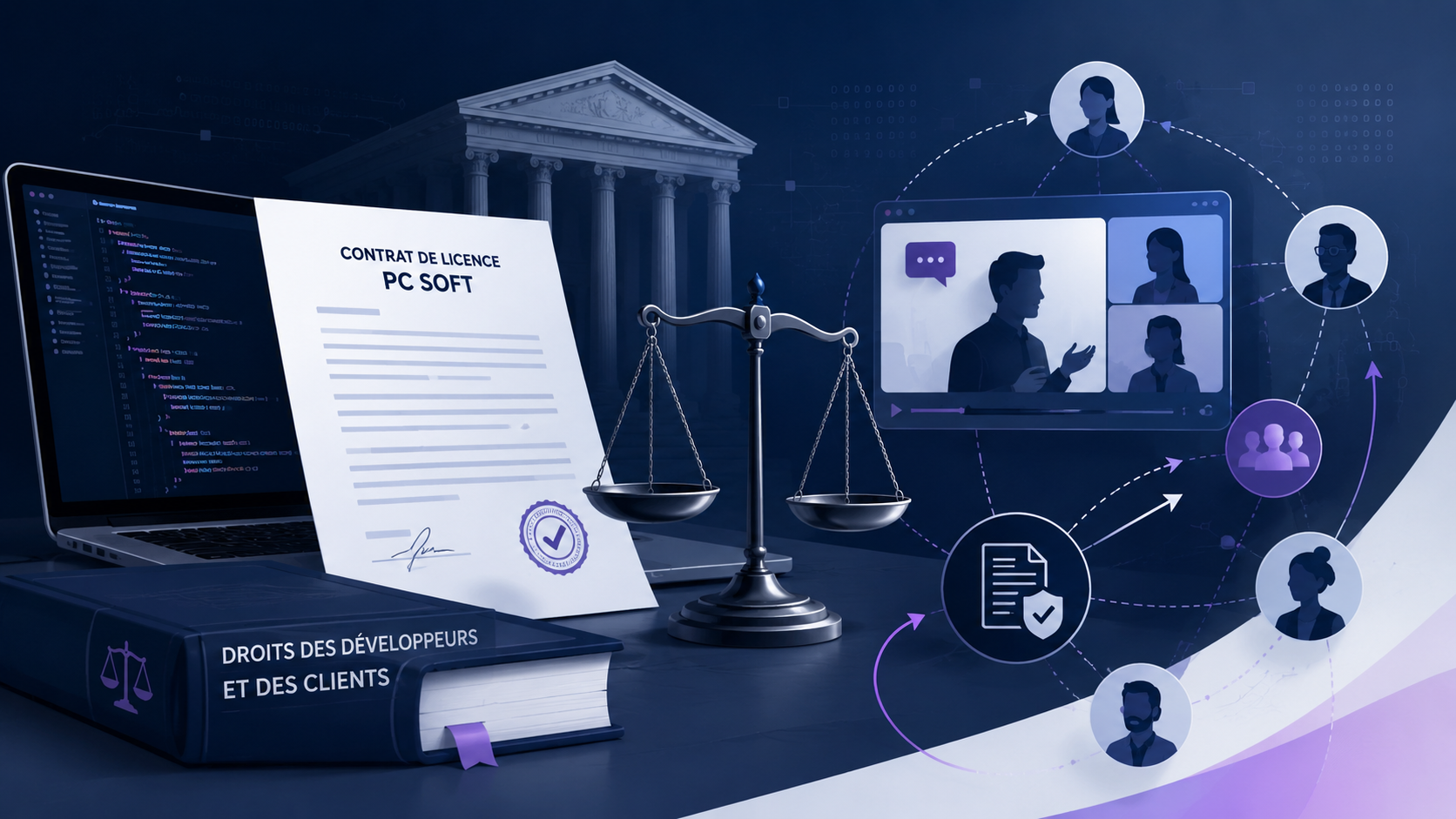
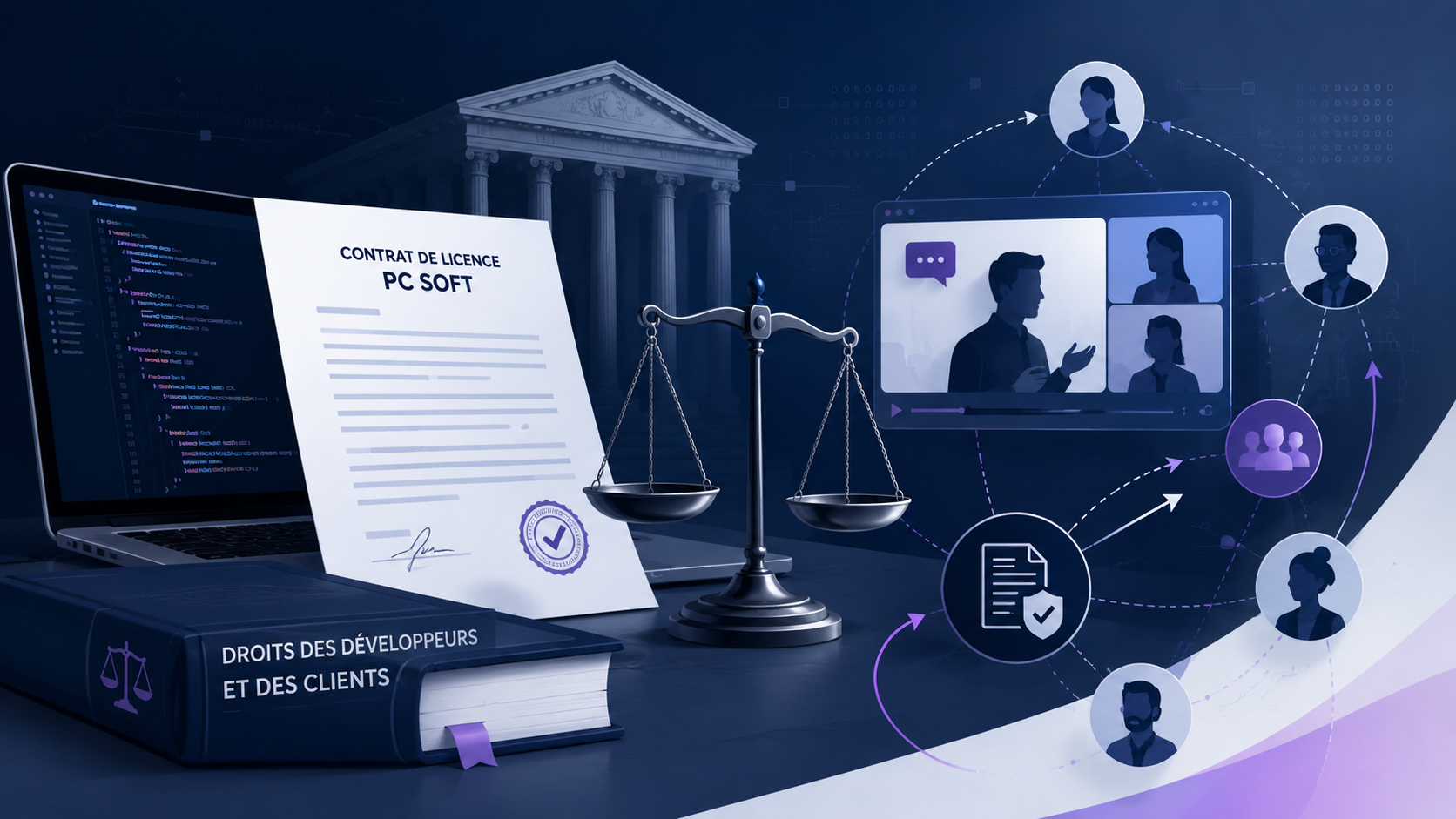
Following the announcements about sessions, audits and the new fee tied to applications built with PC SOFT tools, one question remains: beyond our anger and technical analysis, what rights do we actually have?
We may consider this model unfair, dangerous or economically inconsistent. We can also explain its technical, commercial and contractual consequences for our businesses.
But expressing an opinion is not enough to determine what PC SOFT may legally impose, under which conditions, from what date and with what options for challenge.
01The issue is now entering the legal arena
According to the public announcement shared by Thierry Tillier, the international law firm Linklaters is organizing a webinar on the possible legal remedies in the current situation and on the prospect of a collective approach.
The session should help developers, software publishers, integrators and user companies better understand which legal avenues may be available under their contracts and circumstances.
This does not yet mean that proceedings will be launched, that a class action would be admissible or that it would succeed. The purpose of the webinar is precisely to obtain a serious initial analysis before choosing a strategy.
PC SOFT: legal remedies and collective action
02Thierry is sharing the initiative, not organizing it
It is important to clarify everyone's role.
The webinar is organized by Linklaters. Thierry Tillier is not the organizer and will not speak on the firm's behalf about the legal issues.
Thierry is sharing the information with the WINDEV community. He is collecting requests sent to contact@coursdinfo-video.fr and forwarding them to the firm so that interested people can receive the registration procedure.
In his video, Thierry also says that registration is free and that participants' identities will remain confidential.
03Thierry's announcement video
Thierry presents the event, its purpose and the process for requesting registration.
04Why I am sharing this message
So far, most discussions have focused on session pricing, user counting, executables grouped within a single solution, WEBDEV environments, declarations, audits, and the financial consequences for developers and their customers.
These analyses are necessary. They help us understand how the new model works and assess its risks.
But on their own, they cannot establish what is legally enforceable.
An independent developer, a software publisher, an IT department, an integrator and an end customer do not necessarily have the same contracts. Some still use licences that were historically presented as perpetual. Others have accepted new offers, renewed a subscription or signed an amendment.
The versions of the general terms, order forms, commercial discussions and written commitments may also differ from one company to another.
There is therefore unlikely to be a single answer that applies to the entire PC SOFT ecosystem.
05A legal analysis has become essential
Moving from a developer licence or subscription model to pricing tied to the use of end-user applications raises many difficulties.
Some of the applications concerned were developed ten, fifteen or twenty years ago. They are embedded in the daily operations of businesses, associations and public bodies. Replacing them may require years of work, a full rewrite, data migration and changes to business processes.
This technological dependency makes any contractual change particularly sensitive.
Several issues must therefore be distinguished: the right to use a version already acquired, access to new versions, renewal conditions, application of the new metrics, audit rights and the consequences of refusing to sign a new offer.
Only an analysis of the contracts, applicable general terms and commercial correspondence can provide serious answers to these questions.
06A collective approach still needs to be built
The term “collective action” is naturally appealing when an entire community feels affected by a decision.
But bringing together many dissatisfied developers does not automatically create a legally actionable case.
It will be necessary to identify the people and companies actually affected, compare contracts, distinguish different situations, document any losses and determine the legal form a joint approach could take.
Some parties may already have accepted the new conditions. Others may still be covered by an older offer. Some market their own software, while others use WINDEV only for internal applications.
A joint approach can take several forms: sharing the cost of legal analysis, coordinated negotiation, forming a representative group, or individual proceedings based on similar legal grounds.
The webinar should help establish what is realistic before any strategy or proceedings are announced.
07Collective action and class action are not the same
Since the law of 30 April 2025, France has had a unified class-action regime. It may concern several natural or legal persons in a similar situation who suffer the consequences of the same breach, or breaches of the same nature, of legal or contractual obligations.
Proceedings may seek an end to the breach, compensation for losses, or both. They are not initiated merely because a group of companies or developers decides to come together. The law reserves standing to certain entities, including approved associations or organizations that meet the statutory requirements.
The expression “collective action” can therefore cover several different approaches: jointly funded legal analysis, coordinated negotiation, individual actions based on common grounds, or, where the legal requirements are met, a formal class action.
08Moving beyond isolation
The PC SOFT ecosystem includes very different profiles: independent developers, small software companies, integrators, large organizations, public authorities and customers with decades of WLanguage applications.
Individually, each party has little information about the conditions offered to other customers. Prices may be negotiated, scopes are defined commercially and contracts vary from one company to another.
PC SOFT has an overall view of its contracts and negotiations. Each customer generally knows only its own situation.
This information imbalance makes comparisons difficult.
At a minimum, a collective approach could make it possible to compare situations, share the cost of legal analysis and identify genuinely common clauses.
Even if no proceedings are ultimately brought, sharing this information could help each company understand its position and prepare for its next renewal.
09How to request registration
The webinar is scheduled for Friday, 7 August 2026 at 4:00 p.m., Paris time.
To request registration, send an email to Thierry Tillier at: contact@coursdinfo-video.fr.
Thierry will then forward the request to Linklaters so that the registration procedure can be provided.
To make processing easier, you can use a clear subject line, for example: Registration request for the Linklaters webinar – PC SOFT.
10Prepare facts, not just opinions
For a legal analysis to be genuinely useful, it must be based on concrete evidence.
Depending on your situation, it may be useful to gather:
- the original PC SOFT contracts and licences;
- the different versions of the general terms you received;
- order forms and invoices from recent years;
- any amendments or new offers proposed;
- written correspondence with sales teams;
- documents presenting certain licences as perpetual;
- information provided about session counting;
- any requests to declare or inventory applications;
- a documented estimate of the financial impact of the new model.
An opinion, even one that is widely shared, is not enough to build a case. Contracts, dates, commercial promises, licence versions and financial consequences will be far more useful.
I have already set out my views at length on PC SOFT's new policy. I continue to believe that this fee creates a major breach of trust with the developers and publishers who built their products using WINDEV, WEBDEV and WINDEV Mobile.
But anger, however legitimate, is not enough. We now need to move beyond individual reactions and establish what the contracts genuinely allow us to challenge.
We must retrieve our documents, understand our rights and determine whether a joint approach can be built around legally comparable situations.
I am therefore sharing Thierry's message: watch his video, contact him if you are directly affected and prepare the documents relating to your own situation.
The webinar may not provide every answer immediately. It may nevertheless establish a serious legal framework for an issue that now extends far beyond a simple commercial debate.
SSources and editorial framework
- Thierry Tillier — PC SOFT: Linklaters webinar on legal remedies and collective action
- Louis Planquart — PC SOFT crossed the line
- Louis Planquart — PC SOFT confirms its per-session fee
- Linklaters — the firm in France
- Linklaters — Class Actions and Mass Claims practice
- Légifrance — Article 16 of Law No. 2025-391 of 30 April 2025 on class actions
- Légifrance — procedure applicable to class actions
Editorial framework and no legal advice
This article shares a publicly announced initiative and offers a personal analysis of its relevance to the PC SOFT ecosystem. It is not legal, tax, accounting or contractual advice. The availability of any remedy depends on each person or company's circumstances, contracts and documents.
This article is not sponsored, validated or approved by Thierry Tillier, Linklaters, PC SOFT or Volaris Group. Thierry Tillier is sharing the event and forwarding registration requests, but he is not the webinar organizer.

Comments
0 commentsNo published comments yet. Be the first to respond.