
For a long time, I defended PC SOFT when it moved from a perpetual license to a subscription. I could understand that a continuously maintained professional IDE, required to keep pace with Windows, Android, iOS, browsers and app-store rules, needs recurring revenue. But a line has now been crossed: the cost is no longer confined to the developer's tool. It extends to the use of applications delivered to our own customers.
01 Why I defended the subscription
Many developers rejected the move to subscriptions. I could understand the principle behind it.
A modern IDE is not maintained for free. It must keep up with operating systems, hardware architectures, browsers, mobile SDKs, store requirements and new security rules. Regressions must be corrected, frameworks maintained and support financed.
Charging the developer who uses the tool therefore did not seem unreasonable to me. I could even accept a higher subscription if it guaranteed a more stable IDE, regular updates and better visibility on the roadmap.
The current problem is not that PC SOFT charges for its products. The problem is where that billing boundary ends.
02Volaris and the change in context
The ownership structure changed on May 26, 2025, when Volaris Group announced the acquisition of PC SOFT. Volaris is a group specializing in the acquisition and development of vertical-market software businesses.
An acquisition does not constitute, in itself, proof of a causal link with a price change. It would therefore be excessive to assert that Volaris directly imposed the session-based model without an official document establishing it.
On the other hand, the chronological proximity between the acquisition, the redesign of the offers and the appearance of new metrics gives developers reason to question the long-term monetization strategy of the ecosystem.
03 What the new session model reveals
The new plans page does more than sell developer seats or support services: each plan includes a volume of sessions.
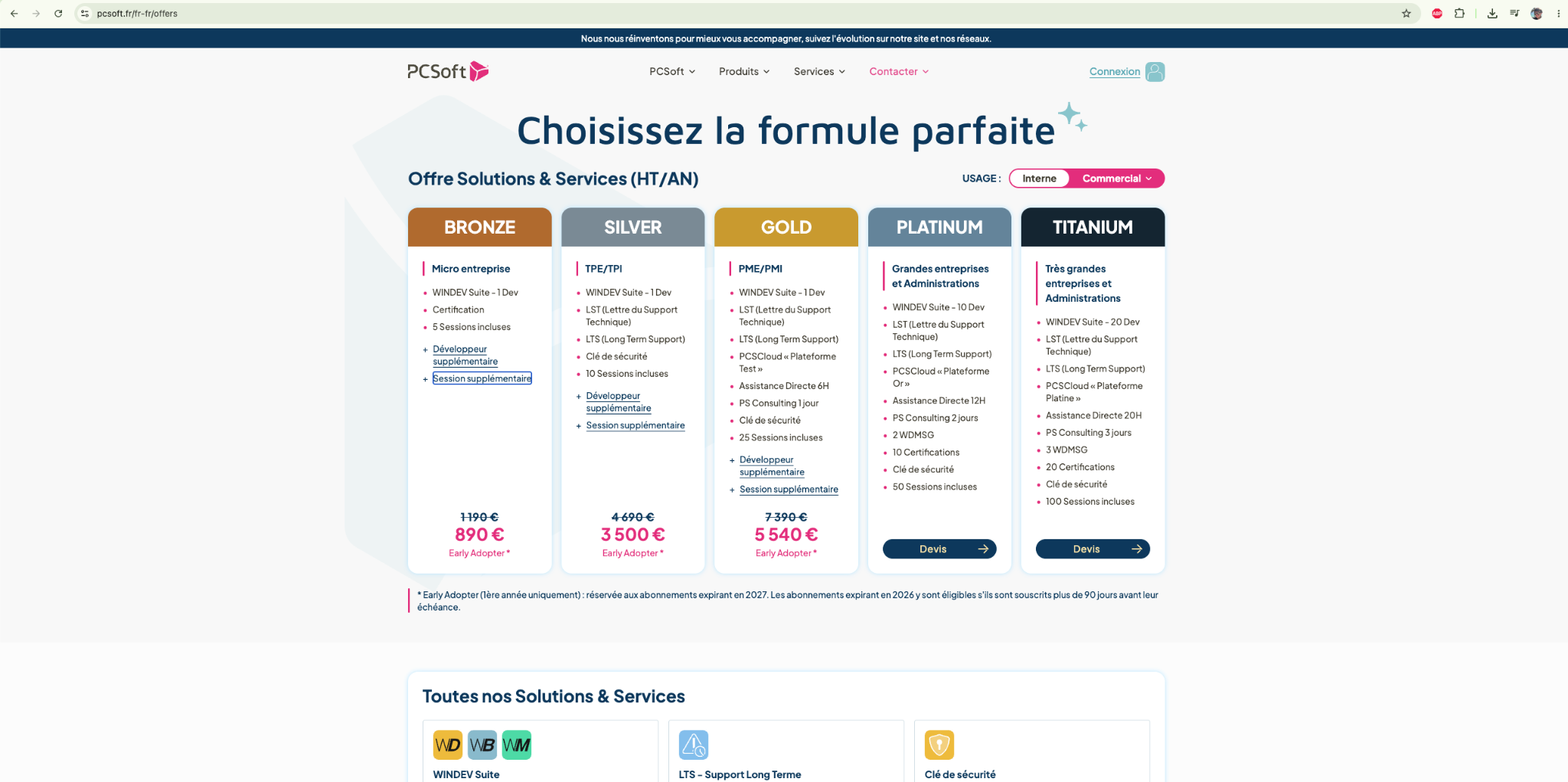
The screenshot for an additional Bronze session indicates a list price of 290 euros. An Early Adopter offer with a one-year commitment displays a price of 200 euros, while a three-year loyalty plan has progressive pricing.
The PC SOFT General Terms and Conditions of Sale, version 1.6 of March 25, 2026, define “metrics” as units of measurement and quantitative limits used to determine the extent of usage rights: users, workstations, environments, CPU cores, etc. They also specify that the Order Form sets the applicable metric, price and scope.
Finally, the General Terms and Conditions remind us that the commercial pages are not contractual and may change. It is therefore the Order Form that must be read carefully. However, this does not change the basic observation: the measured use of the solution becomes a component of invoicing.
- commercial offers are now differentiated by a number of sessions included;
- an additional session appears as a separate billable option;
- the General Terms and Conditions explicitly define quantitative usage metrics;
- the Order Form becomes the central document for price, duration and metrics;
- offers, packages, options and metrics may change for new orders;
- the right to a fixed version itself remains governed by the latest Order Form.
04 The end customer has not chosen PC SOFT
My customer did not purchase WINDEV. They bought a business application that met their needs.
PC SOFT
Provides the IDE, WLanguage, frameworks, compiler and related technical tools.
The developer
Analyzes, designs, codes, tests, deploys, documents, maintains and assumes the commercial relationship.
The end customer
Funds a business solution, then often pays maintenance or a subscription to the service provider that delivers it.
For the customer, PC SOFT is a component of the production chain. They generally know neither WLanguage nor HFSQL nor the IDE's licensing terms. They want functional, maintainable and economically predictable software.
However, I will have to explain to certain clients that after having financed their tailor-made application and paid for its maintenance, they must now finance an additional metric linked to the technology used to build this application.
05 A breakdown in economic confidence
A price increase can be absorbed when it is known, predictable and applied to the renewal of a tool.
The situation becomes much more difficult when a publisher modifies the economics of software already sold, deployed and covered by maintenance contracts.
Existing contracts
The prices were negotiated without incorporating this new recurring charge.
Legacy applications
Software that has been in production for years cannot be rewritten instantly.
Small margins
Free, internal applications or applications intended for small organizations may become unprofitable.
Predictability
It is becoming more difficult to quantify the total cost of an application over five or ten years.
The T&Cs allow PC SOFT to create, modify, group or delete offers, packages, options and metrics for new orders. Prices remain firm during the period already paid, then may change upon renewal subject to the notice provided.
These clauses are standard in professional subscription agreements. However, they become much more sensitive when the metric affects already deployed applications and customers locked into business software.
06 Unity has already tried this switch — and had to back down
The software industry has already experienced a very similar episode with Unity.
In 2023, the game engine publisher wanted to go beyond the traditional subscription per developer seat by introducing a “Runtime Fee”. The principle consisted of billing certain games that had reached significant thresholds, depending on the use of the Unity runtime in the distributed products.
The method was not strictly identical to that of PC SOFT. Unity targeted the video game market and had defined revenue and usage thresholds. But the strategic change was comparable: the publisher no longer just wanted to monetize the creation tool. It also wanted to take a cut after delivery, depending on the use or success of the final product.
Unity has also committed to letting developers continue to use an existing version under previously agreed terms, as long as they remain on that version. This type of guarantee, often called “grandfathering”, is precisely what protects legacy projects against a retroactive modification of the economic model.
The Unity precedent shows that an ecosystem can tolerate an increase in the price of the IDE, but far less readily accept unpredictable charges that follow an application after delivery.
07 What .NET, Swift and OpenJDK do: why the other models are not equivalent
The comparison with large modern ecosystems must remain precise: nothing is completely free, but the border between the development tool, the runtime, the support, the cloud and the distribution is generally much clearer.
.NET
Microsoft states that .NET languages, compilers, libraries, and runtimes are free, including for commercial use. Visual Studio Professional, Azure, and support may be chargeable, but there is no general per-end-user fee for running a .NET application.
Swift and Apple
Swift is released under the Apache 2.0 license with Runtime Library Exception. Apple charges in particular for its developer program and distribution on its platforms. This cost relates to access to the Apple ecosystem, not to each end user simply because the application was written in Swift.
OpenJDK
OpenJDK is distributed under GPLv2 with the Classpath Exception. Some commercial Java distributions and support contracts charge a fee, but the OpenJDK ecosystem does not rely on a general fee per user of the application.
The essential difference is therefore not the total absence of invoicing. It depends on the nature of what is invoiced: the IDE, an infrastructure, support, a store or a service operated in production. The cost is not automatically tied to every user of the final software.
Engines like Unreal Engine constitute a partial counterexample, since they can charge royalties. But thresholds, rates and exclusions are published in advance and generally linked to product revenue. The developer can therefore integrate them into their business model.
08 Consequences for the ecosystem
- review of existing maintenance contracts;
- difficult negotiations with customers who have never chosen PC SOFT;
- reduced margins for small software vendors and independent developers;
- economic risk for free or nonprofit software;
- acceleration of migrations to more open stacks;
- cost of rewriting legacy applications;
- reconsideration of new WINDEV projects;
- increased risk of technological dependence.
The subject has also gone beyond discussions between developers. Two written questions were published by the National Assembly in June 2026 on the commercial practices of PC SOFT, the royalty applied to deployed applications and the economic and strategic consequences for the French ecosystem.
The topic has gone beyond forums and developer associations. Two written questions were published by the National Assembly in June 2026.
The first question asks the Government about the commercial practices of PC SOFT and the consequences of a fee applied to applications developed and deployed for customers.
The second broadens the debate to economic consequences, technological dependence and security and sovereignty issues for user companies and administrations.
09 What PC SOFT could have done
- clearly increase the price of the developer subscription;
- sell truly optional premium support;
- charge for hosting or infrastructure actually provided;
- offer usage-based cloud services;
- maintain a redistributable runtime without usage fees;
- permanently protect already deployed applications;
- publish a simple, stable and capped metric;
- guarantee existing conditions for a fixed version.
10 What this changes for me
I have worked for many years with WINDEV, WEBDEV and WINDEV Mobile. These tools have real value and have allowed me to quickly produce business applications.
But the productivity of an IDE is no longer enough to justify a choice of architecture. It is also necessary to assess the sustainability of its licensing model, the portability of applications and the publisher's ability to protect its own customers.
This policy therefore confirms a decision already made: to gradually migrate my applications to more open stacks, whose runtimes are redistributable and whose lifecycle I can control more effectively.
This migration has a cost. It is necessary to rework the interfaces, business logic, HFSQL databases, installation procedures and user habits. But this cost becomes more acceptable than the risk of seeing a third party unilaterally modify the economic model of applications that I have designed, sold and maintained.
S Sources, contractual documents and conditions of use
- PC SOFT — Solutions & Services offers and sessions included
- PC SOFT — General conditions of sale, version 1.6 of March 25, 2026. The document specifies in particular the definition of metrics, the role of the Purchase Order, the evolution of offers and the renewal rules.
- PC SOFT — legal notices and rights relating to logos and images
- PC SOFT — conditions of use of reusable visuals
- Volaris Group — official announcement of the acquisition of PC SOFT, May 26, 2025
- National Assembly — written question no. 16261, published June 23, 2026
- National Assembly — written question no. 16481, published June 30, 2026
- Unity — official deprecation of the Runtime Fee, September 12, 2024
- Unity — history of Runtime Fee and return to per-seat subscription model
- Microsoft — conditions for free and commercial use of .NET
- Swift.org — Swift license
- OpenJDK — licensing and Classpath Exception
- Epic Games — Unreal Engine license and royalties
Nature of the article
This article reflects my experience and personal opinion. It does not constitute legal, tax, accounting or contractual advice. Prices and conditions may change, readers must check the applicable Order Form, the license and the General Terms and Conditions applicable to their own situation.
Trademarks and no affiliation
PC SOFT, WINDEV, WEBDEV, WINDEV Mobile, HFSQL and WLanguage are trademarks, products or distinctive signs belonging to PC SOFT Informatique or their respective owners. Unity, Unreal Engine, .NET, Swift and OpenJDK are also owned by their respective owners.
Their mention is strictly informative and comparative. This article is not sponsored, validated or approved by PC SOFT, Volaris Group, Unity or the other companies mentioned.
PC SOFT visual assets
PC SOFT images and logos are protected. Any reuse must comply with PC SOFT's official terms and, when required, be subject to written authorization. This article does not include any PC SOFT visuals.
Right of reply and rectification
Any company or person cited may request review of a factual correction or the addition of a right of reply using the contact details available on this site.
Copyright
Unless otherwise stated, the original text, its structure and formatting belong to Louis Planquart. Any full reproduction or commercial exploitation requires prior authorization.
Comments
0 commentsNo published comments yet. Be the first to respond.